
By Zetexa Global · Published · Updated
Travel Connectivity Report 2026: How Travelers Buy eSIM and Airport Services Through Fintechs, OTAs and Banks
Key findings
- 1.52 billioninternational tourist arrivals were recorded in 2025, up 4% on 2024. UN Tourism expects another 3–4% growth in 2026.
- US$1.8 billionwas spent on travel eSIM packages in 2025, up 85% from US$989 million in 2024 (Juniper Research).
- ~930 milliontravel eSIM activations are expected by 2030, up from about 46 million in 2023. That is roughly 54% growth a year (Roland Berger).
- About 45%of travel eSIM activations are expected to come through super-apps, fintechs and neobanks, OTAs and airlines by 2030 (Roland Berger).
- 3.3%of Opensignal's global users were on a travel eSIM in Q2 2026, nearly double the 1.7% a year earlier. Roaming lost 5.2 percentage points over the same period.
- US$28is the average travel eSIM spend per trip, up 133% year on year. Average roaming spend per trip fell 9% to US$42 (Kaleido data, via Opensignal).
- 10%of smartphone connections worldwide will run on eSIM by the end of 2026, double the 5% at the end of 2025. In the US, the share is already about half (GSMA Intelligence).
- 73%of travelers have used an airport lounge or another premium airport service at least once (survey of 12,067 travelers in 21 countries).
- 90%of cardholders in Asia-Pacific expect airport lounge access on payment cards that charge an annual fee.
In short
In 2026, more travelers are switching from roaming to travel eSIM. More of them will buy it from apps they already use, such as their bank, travel app or airline, and less often from a telecom company.
How big is the travel eSIM market in 2026?
Travel eSIM is still a small part of what travelers spend on connectivity, but it is growing far faster than roaming.
Juniper Research puts global spending on travel eSIM packages at US$1.8 billion in 2025, up 85% from US$989 million in 2024. The firm expects more mobile operators to launch their own travel eSIMs in 2026 to hold on to roaming customers.
Activations are growing even faster than revenue. Roland Berger expects travel eSIM activations to rise from about 46 million in 2023 to about 930 million by 2030, a growth rate of roughly 54% a year.
The pool of travelers keeps growing too. UN Tourism counted 1.52 billion international tourist arrivals in 2025, almost 60 million more than in 2024, and expects arrivals to grow another 3–4% in 2026. Every one of those trips needs mobile data from the moment the traveler lands.
How do travelers stay connected abroad?
Roaming is still the most common way to get online abroad, but it is losing ground to travel eSIM.
- Users are switching.Travel eSIM users nearly doubled among Opensignal's global users, from 1.7% in Q2 2025 to 3.3% in Q2 2026. Roaming fell 5.2 percentage points over the same period.
- Travelers spend more on eSIM, less on roaming.Average travel eSIM spend per trip rose 133% to about US$28. Average roaming spend per trip fell 9% to US$42 (Kaleido data, via Opensignal).
- Bigger plans.15% of travel eSIM users now buy unlimited plans. Price is no longer the only reason travelers choose eSIM. They want to know what they are buying and what happens when the data runs out.
More phones can now take an eSIM
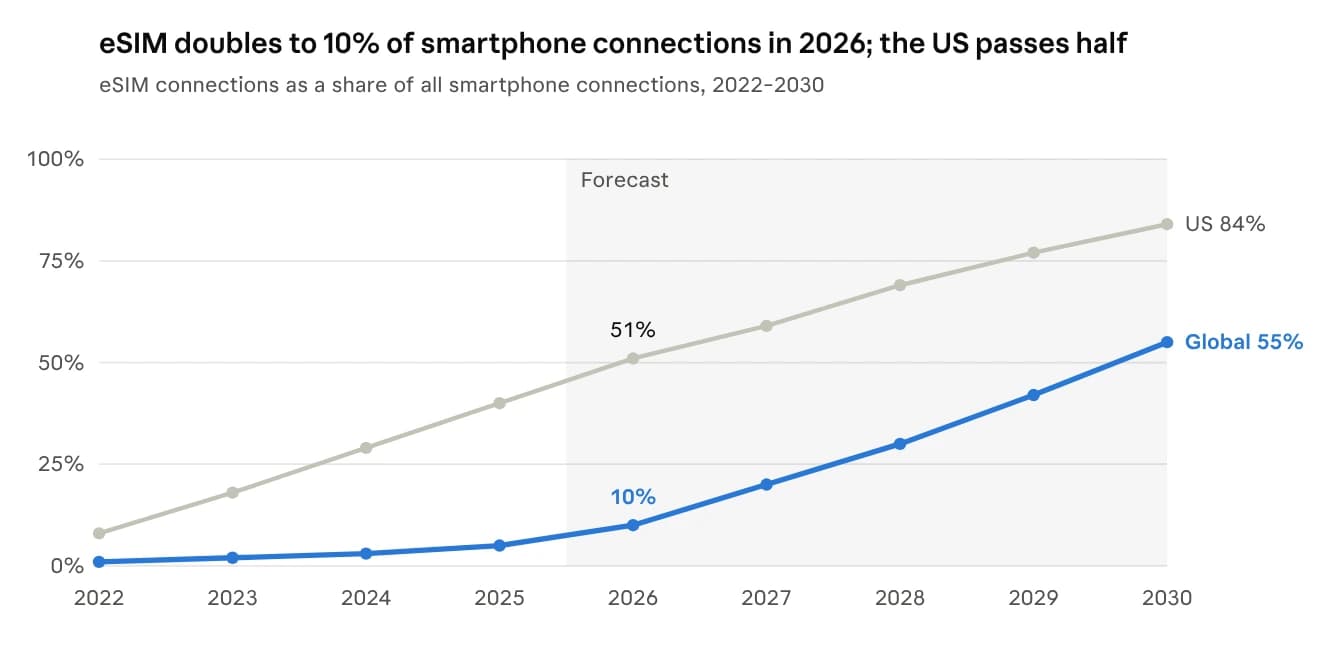
Chart: Zetexa Global. Data: GSMA Intelligence, "eSIM: the time is right to push adoption" (March 2026). 2026–2030 are forecasts.
Two changes in late 2025 sped this up: Apple took its eSIM-only iPhones to more markets, and China's three largest operators began commercial eSIM smartphone trials. By 2030, GSMA Intelligence expects eSIM connections to outnumber physical SIM cards worldwide.
Where do travelers buy eSIM?
The next wave of travel eSIM sales will come through apps travelers already use, not only through telecom stores.
Roland Berger expects about 45% of travel eSIM activations to come through B2B2C channels by 2030. It names four: super-apps, fintechs and neobanks, online travel agencies (OTAs) and airlines. In these models, the brand sells the eSIM inside its own app or website, and a connectivity platform runs the network side.
Why these brands want to sell eSIM
| Channel | Why travelers buy there | What the brand gains |
|---|---|---|
| Banks, fintechs and neobanks | The card is already in the traveler's hand, and the app is open for every payment abroad | A new reason to open the app on every trip, plus fee income |
| OTAs | Connectivity is bought at the same time as the flight or hotel | A higher basket value per booking |
| Airlines | The trip is confirmed and the traveler is checking in | Ancillary revenue before take-off |
| Super-apps | One app already covers payments, rides and messaging | More time and spend inside the app |
Market examples
- A digital bank in the UKIn February 2024, Revolut launched travel eSIM data plans inside its banking app. Its top subscription tier includes 3GB of data a month for use abroad. The company said the aim was to become "the financial super app".
- A digital bank in EuropeIn May 2026, N26 added a data-only travel eSIM to its banking app, according to Crowdfund Insider.
The other side of the picture
Travelers still trust their home operator. In Kaleido Intelligence's survey of 20 outbound markets, 89% said they would consider buying a travel eSIM from their home operator, and 60% would consider a dedicated travel eSIM provider. Brands that sell eSIM need to match that trust with clear pricing, quick setup and support when something goes wrong.
How do travelers buy airport services?
Airport lounges and fast track used to be perks for business travelers. Today most travelers have used one, and many get access through a payment card.
What travelers use and value
A 2025 survey of 12,067 travelers in 21 countries and territories, run by an airport lounge program, found that:
- 73%had visited an airport lounge or another premium airport service at least once.
- 73%named fast-track security and digital boarding passes as the airport technology they value most.
- 55%eat in the lounge, 46% shop and 37% use the time to relax.
- 37%want to book lounges through an app.
Why card issuers offer lounge access
Research by the same program's operator on payment-card holders found:
- 90% of cardholders in Asia-Pacific expect airport lounge access on cards that charge an annual fee.
- Cardholders who use their lounge benefit spend twice as much as those who do not.
- Card activation in the first six months was twice as high where lounge access was included, compared with overall industry rates.
For a bank or fintech, that makes airport services more than a travel extra. They help win the card, get it activated and keep it in use. The same logic applies to eSIM: both are bought at the same moment, just before or during a trip.
Regional snapshots
Europe has the most travelers, the Middle East is growing fastest against 2019, and Asia-Pacific has the most room to grow.
| Region | International arrivals, 2025 | Change vs 2024 | What it means for connectivity |
|---|---|---|---|
| Europe | ~793 million | +4% (6% above 2019) | The largest travel market. Phones are still catching up on eSIM, so more travelers will be able to use it each year. |
| Asia-Pacific | ~331 million | +6% (still 9% below 2019) | The main growth driver for travel eSIM. China's operators began eSIM smartphone trials in 2025, and China's outbound travel eSIM market could reach about US$656 million by 2030 (Roland Berger). |
| Americas | ~218 million | +1% | The US leads the world on eSIM. About half of US smartphone connections are expected to run on eSIM by the end of 2026. |
| Middle East | ~100 million | +3% (39% above 2019) | Strong growth from big travel hubs, where many travelers pass through on long-haul trips. |
| Africa | Not stated | +8% (fastest of any region) | Rising arrivals, led by North Africa (+11%). |
Arrivals: UN Tourism World Tourism Barometer, January 2026, via PAX News. US eSIM figure: GSMA Intelligence.
What it means for fintechs, OTAs and banks
The brands that own the moment before a trip are now best placed to sell connectivity and airport services. Five things stand out.
- Sell at the moment of travel.Travelers buy eSIM and airport services just before they fly or as they land. A booking confirmation, a card used abroad or an airline check-in is the right time to offer them.
- Bundle connectivity with airport perks.Lounge access helps win and activate cards, and eSIM keeps the app in use abroad. Offered together, they cover the whole trip, from the airport to the hotel.
- Make trust the selling point.Many travelers still trust their home operator most. A brand that sells eSIM needs clear prices, an easy setup and support that answers when the data stops.
- Plan for bigger data needs.More travelers buy unlimited plans and spend more per trip on eSIM. Offer a range of plans, not just the cheapest.
- Do not build the network side yourself.Coverage across 200+ countries means deals with hundreds of networks, plus licenses and compliance. A connectivity platform can handle that, so the brand can focus on its customers.
How Zetexa helps brands sell travel eSIM and airport services
Zetexa Global is one API for the whole travel ancillary stack. Fintechs, banks, OTAs and airlines use it to sell travel eSIM and airport services under their own brand.
- CoverageeSIM data in 200+ countries across 1,000+ networks, with voice and SMS across Pan-Europe and 30+ more countries. The eSIM never expires, so customers can top it up for the next trip.
- Airport servicesLounge access at 403 airports in 115 countries, meet and greet at 106 airports in 37 countries and fast track at 50 airports in 17 countries, plus dining vouchers and VIP services. You can check every airport online.
- Ways to launchAn eSIM API for full integration, a white-label website that can go live in a day, or a Shopify plugin.
- Keeps the app reachableGreen Zone, a premium feature available on request, lets travelers open the partner's app even when their data runs out, so they can top up inside it.
- Licensed and secureZetexa holds MVNO licenses in the USA, Canada, the UK and Australia, and a TDRA SIM trading license in the UAE. It is GDPR-compliant and PCI DSS compliant, and has a SOC 2 Type II report from an independent auditor. Details are in the Trust Center.
- ScaleMore than 2,000 B2B partners already sell through Zetexa.
To talk about adding eSIM or airport services to your app, book a demo with our partner team.
Sources
- 01UN Tourism World Tourism Barometer, January 2026 (via PAX News): 2025 arrivals by region and the 2026 outlook
- 02Juniper Research, "Travel eSIMs Surge as Roaming Alternative – Up 85% in 2025" (October 13, 2025): travel eSIM revenue for 2024 and 2025
- 03Roland Berger, "Travel eSIM: From roaming to digital" (July 22, 2026): activations to 2030, the B2B2C share, China
- 04Opensignal, travel eSIM and roaming webinar (2026): user shares, spend per trip (Kaleido data), unlimited plans, channel preference
- 05GSMA Intelligence, "eSIM: the time is right to push adoption" (March 2026): global and US eSIM adoption, 2022–2030
- 06GSMA, "eSIM mass market deployment moves from forecast to fact" (May 1, 2026): late-2025 drivers
- 07CNBC via NBC New York, "Digital banking giant Revolut is launching phone plans for travelers in the UK" (February 12, 2024): fintech market examples
- 08Airport lounge program survey of 12,067 travelers (July 2025): lounge use and airport technology
- 09Lounge program operator research on card issuers: cardholder expectations, spend and activation
FAQ
Juniper Research estimates that travelers spent US$1.8 billion on travel eSIM packages in 2025, up 85% from 2024. Roland Berger expects activations to reach about 930 million a year by 2030.
Yes. Travel eSIM users nearly doubled among Opensignal's global users between Q2 2025 and Q2 2026, while roaming lost 5.2 percentage points. Roaming is still the most common choice, but its share is falling.
GSMA Intelligence expects 10% of smartphone connections worldwide to use eSIM by the end of 2026, and 55% by 2030. In the US, the share is already about half.
Their apps are already open when customers pay abroad. Selling eSIM gives travelers a reason to keep using the app on every trip. Roland Berger expects about 45% of travel eSIM activations to come through super-apps, fintechs, OTAs and airlines by 2030.
Yes. In Asia-Pacific, 90% of cardholders expect lounge access on cards with an annual fee. Cardholders who use the benefit spend twice as much as those who do not.
Yes. Platforms such as Zetexa provide the networks, licenses and airport partners through one API, a white-label website or a Shopify plugin. The brand keeps its own name and customer relationship, and pays only for what it sells (how partner pricing works).
Still have questions?
Our team can walk you through it.