
Embedded eSIM for Customer Engagement: How Every Top-Up Brings Customers Back to Your App
Most travel add-ons are bought once. Embedded eSIM brings customers back to your app with every usage check and top-up. See how the loop works with Zetexa.
Quick answer: Most travel add-ons are bought once and forgotten. An embedded eSIM works differently. Customers install it once, check their data during the trip, top it up when they run low, and keep it on their phone for the next journey. Each of these moments happens inside the partner's own app. With Zetexa's eSIM API, fintechs, banks and travel brands can turn connectivity into a repeat reason to open their app, across 200+ countries and 1,000+ networks.
In the changing landscape of digital finance and travel, getting a customer to download an app is no longer the hard part. Bringing them back is. CleverTap's fintech benchmark found an average stickiness (daily users divided by monthly users) of 22%, which means only about one in five monthly users opens a fintech app on a typical day. In the UK, UXCam's 2026 benchmark puts the median fintech app at 4.75 sessions per user a month.
One might assume that adding more products to the app will naturally fix this. But this is not the case. Most travel ancillaries, such as lounge passes, Fast Track and travel insurance, are bought once and then forgotten until the next trip. The customer comes in, pays and leaves.
However, a travel eSIM behaves like no other add-on. It is used every hour of the trip, it runs out, it needs checking, and it can be topped up from anywhere. Hence, when it lives inside your app, every one of those moments brings the customer back to you.
In this blog, we explain why eSIM drives repeat engagement, how the top-up loop works, what the market shows, and how to design and measure it with Zetexa.
Why Are Most Travel Ancillaries One-Time Purchases?
Most travel ancillaries are used at a single point in the journey, so the customer has no reason to return to the app after buying them. A travel eSIM is the exception, because it is used every day of the trip and can be refilled.
| Ancillary | When it is used | How often it brings the customer back |
|---|---|---|
| Airport lounge pass | Once, before departure | Once per trip |
| Fast Track | Once, at security | Once per trip |
| Meet & Greet | Once, on arrival or departure at the airport | Once per trip |
| Travel insurance | Only if something goes wrong | Rarely |
What Does This Look Like for a Real Customer?
Take a scenario where Maya, a customer of a US neobank, is flying to Lisbon for ten days. Before the trip, she buys a lounge pass and travel insurance in her banking app. Both are useful, but neither brings her back to the app once she lands. Now imagine she also buys a 5 GB Portugal eSIM in the same app.
- Day 1: She lands, the eSIM connects, and her banking app is the first place she checks her data.
- Day 3: A usage alert tells her that most of her data is gone. She opens the app to see her balance.
- Day 3, a few minutes later: She tops up in a few taps, with her saved card and no new login.
- Day 10: She flies home. The eSIM stays on her phone.
- Four months later: She plans a trip to Mexico and tops up the same eSIM for Mexico from the app, with no new QR code and no new install.
That is five visits from one product, compared with one visit each for the lounge pass and the insurance. Please note that this pattern is not unusual. Zetexa's own usage data shows that an eSIM uses around 1.6 GB per day on average, with the heaviest use in the first two days of a trip. Hence, a 5 GB pack on a ten-day trip will often need at least one top-up.
What Makes eSIM a Repeat Product?
- It is used daily: Maps, messaging, ride-hailing and payments all run on mobile data.
- It runs out: Data packs are finite, so customers keep an eye on their balance.
- It can be topped up anywhere: Zetexa's lifetime eSIM never expires and can be topped up for any country.
- It stays on the phone: The next trip starts with a top-up, not a fresh install.
- It sits next to money: Customers top up with the same card and app they already trust.
How Does the eSIM Engagement Loop Work?
The eSIM engagement loop is the cycle of buying, installing, using, topping up and reusing an eSIM, where every step happens inside the partner's app rather than a third-party eSIM app.
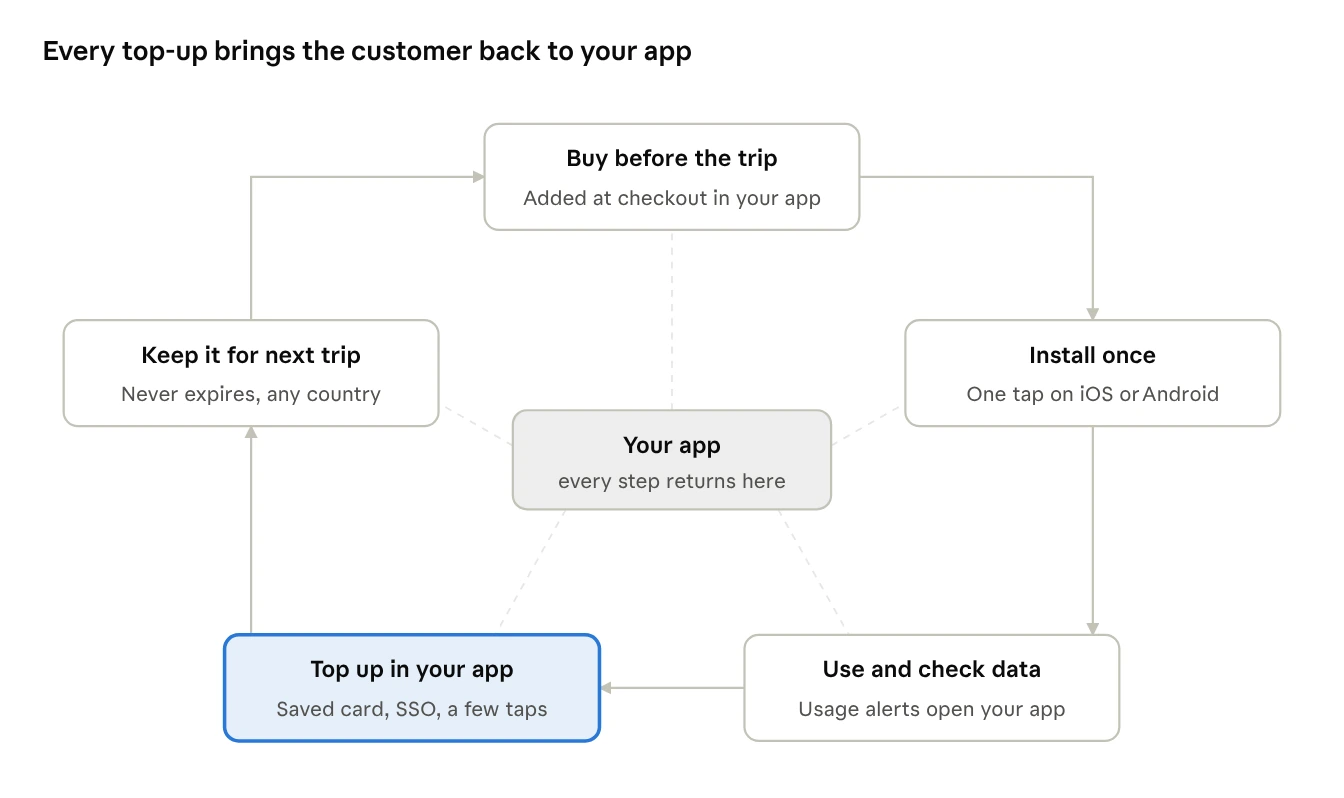
The eSIM engagement loop · 5 steps, each one inside the partner's app
It is evident that the loop does not end when the trip ends. Because the eSIM stays on the phone and never expires, the next trip starts with a top-up in your app, and the cycle begins again.
What Does the Market Show About eSIM and Engagement?
The market shows two things at once: travel eSIM is growing fast, and standalone eSIM apps struggle to bring customers back. The brands that win repeat use are the ones that already own a daily relationship with the customer.
Travel eSIM Is Growing Fast
According to Juniper Research, revenue from travel eSIM packages reached $1.8 billion in 2025, up 85% from $989 million in 2024. Juniper also forecasts that this will reach $8.7 billion by 2030.
Standalone eSIM Apps Struggle With Repeat Use
However, growth alone does not create loyalty. As Inside Telecom puts it, a product that is bought once per trip, used for a week and then deleted is a discovery business, not a subscription business. Standalone eSIM sellers have to win the customer again before every trip, often through paid ads.
It is important to note that a fintech or travel brand does not have this problem. The customer already opens the banking or travel app for payments, bookings and balances. Hence, the eSIM does not need to create a new habit. It only needs to add more reasons to an existing one.
Revolut Built eSIM as an In-App Habit
Revolut launched eSIM for its EEA customers in March 2024. Customers install a single eSIM and top it up in a few clicks in the Revolut app whenever they need. Revolut also lets customers with the eSIM connected open its app without using their data allowance, so they can top up even after the data runs out. Additionally, its Ultra plan includes 3 GB of global data that refreshes every month.
It is evident that Revolut did not add eSIM as a one-time travel extra. It built eSIM as a reason to keep the app at the center of the trip.
Zetexa Sees the Same Pattern at Scale
Zetexa powers more than 2 million live eSIM profiles and recorded over 1.5 million activations in the last 12 months. Wholesale data prices fall every quarter. Yet revenue per user has held steady, because travelers use more data and add more ancillaries to their trips. In other words, the value lies in the repeat relationship, not in the first sale.
How Can You Design eSIM for Repeat Engagement?
To design eSIM for repeat engagement, make every step of the loop happen inside your app, remove friction from the top-up, and give customers a reason to come back on the next trip. Zetexa's eSIM API and premium features cover each of these steps:
- Lifetime eSIM: One install, with top-ups for any country. The eSIM never expires, so the next trip starts in your app.
- In-app top-ups: One REST API handles the plan catalog, ordering, top-ups, usage and refunds. With single sign-on (SSO) and the customer's saved payment method, a top-up takes a few taps and no new account.
- Usage alerts: Built-in alerts tell customers when their data is running low. Additionally, a 140-character SMS can reach every user even when the app is closed.
- Green Zone: Your app and website are whitelisted, so customers can open them and top up even with zero data left. We will cover this in Part 2 of this series.
- Rewards on every top-up: A coins-based loyalty and referral engine rewards repeat use. With BIN locking, you can keep special offers for your own cardholders.
- One order for the whole trip: A single order can provision the eSIM and add airport lounge access (760 airports in 143 countries), Fast Track (139 airports) or Meet & Greet (110 airports).
- Your name on the network: With a custom SPN (service provider name), your brand appears as the network name on the customer's phone. We will cover this in Part 3.
What Should You Measure?
One might assume that eSIM revenue is the best measure of success. But this is not the case. For engagement, the better signals are how often customers return and what they do when they come back.
| Metric | What it tells you |
|---|---|
| Top-up rate per active eSIM | How often the eSIM brings customers back during a trip |
| Time from landing to first top-up | When to send your usage alerts and offers |
| In-trip app sessions vs. a normal month | The direct lift in app engagement |
| Reuse rate on the next trip | How many customers top up an existing eSIM instead of buying elsewhere |
| Ancillary attach rate on top-up orders | Whether top-ups open the door to lounges, Fast Track and more |
| Card spend abroad by eSIM users vs. non-users | Whether connectivity lifts your core banking revenue |
Please note that Zetexa shares activation, usage and top-up events through its API and webhooks, so your team can track these metrics in your own analytics tools.
Why Zetexa?
Zetexa is 1 API for the Fintech Travel Stack. It is a US-headquartered company (Dover, Delaware), founded in 2023, and a leading eSIM provider with a complete travel ancillary stack on the same API:
- Coverage: Data in 200+ countries across 1,000+ networks, with voice and SMS across Europe and in 30+ more countries.
- Local plans: Local monthly plans in the USA, the UK, Canada and Australia, with Germany and Hong Kong coming soon.
- Speed: eSIM provisioning typically in under 1.5 seconds; a no-code microsite in a day, or full API integration in 2 to 4 weeks.
- Security: SOC 2 Type II, GDPR and PCI DSS compliance.
- Ownership: You keep the customer, the brand and the pricing.
To see how Zetexa compares with 1GLOBAL, Gigs, Telna and Firsty, read our guide to the Best eSIM API for Fintechs and Neobanks in 2026.
Turn Every Trip Into Repeat Engagement With Zetexa
A lounge pass brings a customer to your app once. An embedded eSIM brings them back on the day they land, every time their data runs low, and again on their next trip. It is evident that connectivity is the one travel ancillary that keeps working for your app long after the first sale.
With Zetexa, you can launch your own branded eSIM in a day with a no-code microsite, or build it fully into your app through one API in 2 to 4 weeks. Book a demo with the Zetexa team to see how eSIM top-ups can lift engagement in your app.
Frequently Asked Questions
What Is Embedded eSIM for Customer Engagement?
Embedded eSIM for customer engagement means selling a travel eSIM inside your own app, so that every purchase, usage check and top-up happens with your brand. Because customers use data every day of a trip, the eSIM gives them repeated reasons to open your app.
Why Do eSIM Top-Ups Increase App Engagement?
Data packs run out during a trip, so customers return to check their balance and buy more. When the top-up happens in your app with a saved card and single sign-on, each top-up is another app session that your brand owns.
Can Customers Reuse the Same eSIM for a New Trip?
Yes. Zetexa's lifetime eSIM never expires and can be topped up for any country. The customer installs it once, and every future trip starts with a top-up in your app.
What Happens if a Customer Runs Out of Data and Cannot Open the App?
With Zetexa's Green Zone feature, your app and website are whitelisted on the eSIM. Customers can open them and top up even when they have zero data left.
How Quickly Can a Fintech Launch eSIM With Zetexa?
A no-code, white-label microsite can go live in a day. A reseller portal or WhatsApp bot can go live within days, and a full API integration usually takes 2 to 4 weeks.
Which Metrics Show Whether eSIM Is Driving Engagement?
The most useful metrics are top-up rate per active eSIM, time from landing to first top-up, in-trip app sessions, reuse rate on the next trip, and ancillary attach rate on top-up orders.
Who Owns the Customer and the Data?
The partner does. With Zetexa, you keep your brand, your pricing and your customer relationship, and you decide how the eSIM appears in your app.
Zetexa for fintechs
Put a travel eSIM inside your app, under your own brand.
One API for eSIM data and airport services in 200+ countries. You keep the brand, the pricing and the customer.
Related posts
Green Zone eSIM: How Zero-Rated Apps Keep Your Brand On When Travelers Run Out of Data
When a traveler's data runs out, most apps go dark. With Zetexa's Green Zone, your app and website stay open, so customers can pay, approve and top up with zero data.
eSIM API UK: Launching White-Label Travel eSIM for UK Fintechs, Travel Brands and Airlines
Launch white-label travel eSIM in the UK with one eSIM API. See how UK fintechs, travel brands and airlines sell eSIM data under their own brand.
eSIM API Canada: CRTC-Ready Travel and Student eSIM for Canadian Fintechs, Banks and Schools
Launch travel eSIM and local Canadian mobile plans under your brand with one eSIM API. Built for Canadian fintechs, banks, universities and colleges.